How patience, openness, and a stray kitten softened the edges of melancholy
Sometimes the seasons shift and leave us feeling a little hollow. On our remote island, summer’s energy has given way to quiet streets and empty playgrounds, and I’ve been missing both the bustle and my own days of teaching. Last night, I found myself naming what I longed for: a little magic.
Lately I’ve been carrying a quiet heaviness. Not depression exactly, just a soft melancholy that comes with the change of seasons. Part of it is back-to-school time. On St. Paul Island, most high schoolers leave for boarding school, and the younger kids are tucked into classrooms instead of filling the streets with laughter. The air feels suddenly still. I miss that energy, and I miss teaching, too. Over the summer, I taught sewing to a group of island teens, and those afternoons rekindled the joy of being around kids, their energy, their chatter, and their curiosity. When the classes ended, the silence felt sharper. And layered beneath it all is the ache of missing my own children in the lower 48, a tug that grows stronger in these quieter seasons.
That night, after I said out loud that I needed magic, I didn’t expect anything to happen. But sometimes words have a way of stirring something.
An hour later, around nine o’clock p.m., our doorbell rang.
It was Chucky, standing there with a trap. Inside: a furious little kitten.
I knew exactly which kitten it was. I’d been trying to find her for weeks. Ever since I’d heard there was a litter of strays born behind a neighbor’s house, I’d been circling by with hopeful eyes, stopping girls from my sewing class for updates, even leaving hot dogs out at midnight when the girls swore the kittens would appear. But, they were elusive, and more than a few families wanted them. After a while, I figured they’d all been claimed. I told myself to let go of the hope.
And then here she was.
She was wild-eyed, spitting and hissing, refusing to come out of the cage. When she finally scrambled free, she shot up the wall, toppled into the sink, startled herself in the mirror, and wedged behind the toilet. Clearly feral, clearly terrified.
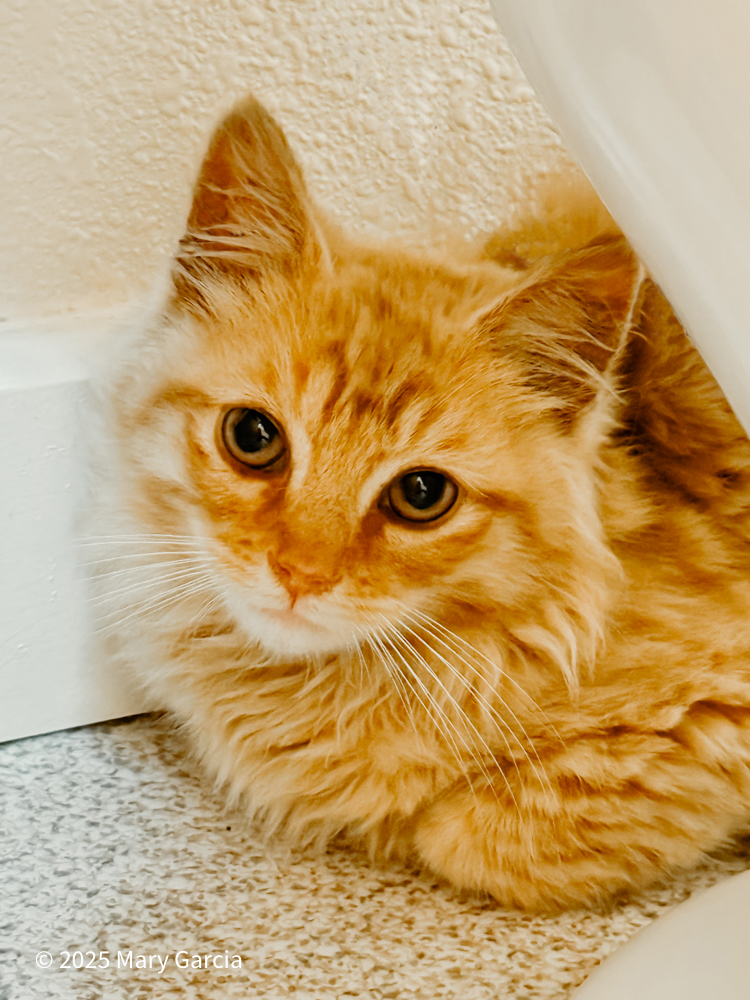
So I sat down on the bathroom floor. And I waited.
At first, even looking in her direction earned a hiss. But hour after hour, I inched closer. My hand hovered, then grazed the top of her head. She tensed but didn’t bolt. Slowly, she allowed me to pet her. By midnight, I tried wrapping her in a towel, not tight, just enough to hold her. To my surprise, she settled into it.
I cleaned the dust from her fur with a damp cloth, softened the dirt in her ears with a touch of mineral oil. And then she purred. A rusty, tentative sound at first, but steady enough to split my heart wide open.
That was the magic.
By one in the morning she had crawled into the crook of my neck, still purring, and we dozed together on the couch until dawn. When she stirred restlessly at five, I carried her back to the bathroom. She’s still there now, nameless, uncertain, and very much my little mystery.
Sometimes we can recognize what’s missing: loneliness, stillness, the absence of magic. And sometimes, when we wait with patience, good things appear at our door.
For me, it came as a tiny kitten, conjured on the very night I said out loud that I needed a little bit of magic.
The Cats of St. Paul Island
Cats first arrived in the Pribilofs in the late 1700s with Russian ships, traveling as shipboard mousers. Many stayed behind as people settled the islands.
By the early 1900s, cats were already part of village life—outlasting horses, cattle, and poultry.
In 1916, schoolteachers George and Mrs. Haley introduced a female Manx-descendant cat from the Isle of Man. Her lineage blended into the local population.
Today’s strays are hardy survivors—descendants of Russian ship cats, Manx imports, and natural selection in a harsh climate. They aren’t a single breed, but a unique Pribilof landrace—part of the island’s living history.


Leave a reply to Mary Garcia Cancel reply