
Today is Juneteenth, a day when many Americans pause to remember the delayed arrival of freedom in Texas, and the long struggle to bring hidden, resisted, and minimized histories into public memory.
Here on St. Paul Island, people gathered last week for another act of remembrance: the annual evacuation walk.
The histories are not the same, and I do not want to flatten them into one story. But they are connected by the work of bringing truth into the open. Juneteenth reminds us that freedom can be delayed and truth can be withheld. The evacuation walk reminds me that other histories, too, can be left untaught for generations, even when they happened here, on American soil, within living memory.
I think that is one reason these acts of remembrance matter. They ask us to look honestly at the past, not to dwell there, but to better understand the present. The stories we leave out can be just as important as the ones we tell. When difficult histories are forgotten, minimized, or left untaught, we lose the opportunity to learn from them.
I am still learning this history, and I share it with care, knowing it belongs first to the Unangan families and community members whose lives and ancestors were shaped by it. I do not write as an authority, but as someone who was invited to walk, listen, and remember alongside others.
I share it because I did not know this history until I moved here. I did not know that this happened on American soil, in living memory, to people whose children and grandchildren still carry the story. This was not distant history. This was the time of our parents, grandparents, aunts, uncles, brothers, sisters, and neighbors. I should not be surprised by how much was left untaught, but I still am.
The walk begins at the St. Paul Island ball field. People were playing baseball there in 1942 when the Delarof arrived.
This year, the remembrance began with an elder retelling the history, followed by the signing of the large book that has become part of the island’s tradition. From there, we walked the short distance to East Landing, where, in 1942, residents boarded the Delarof and left the island. Along the way, there was drumming and singing in Unangam Tunuu. At the monument near the landing, prayers were offered by the Russian Orthodox priest, and flowers were placed in remembrance.
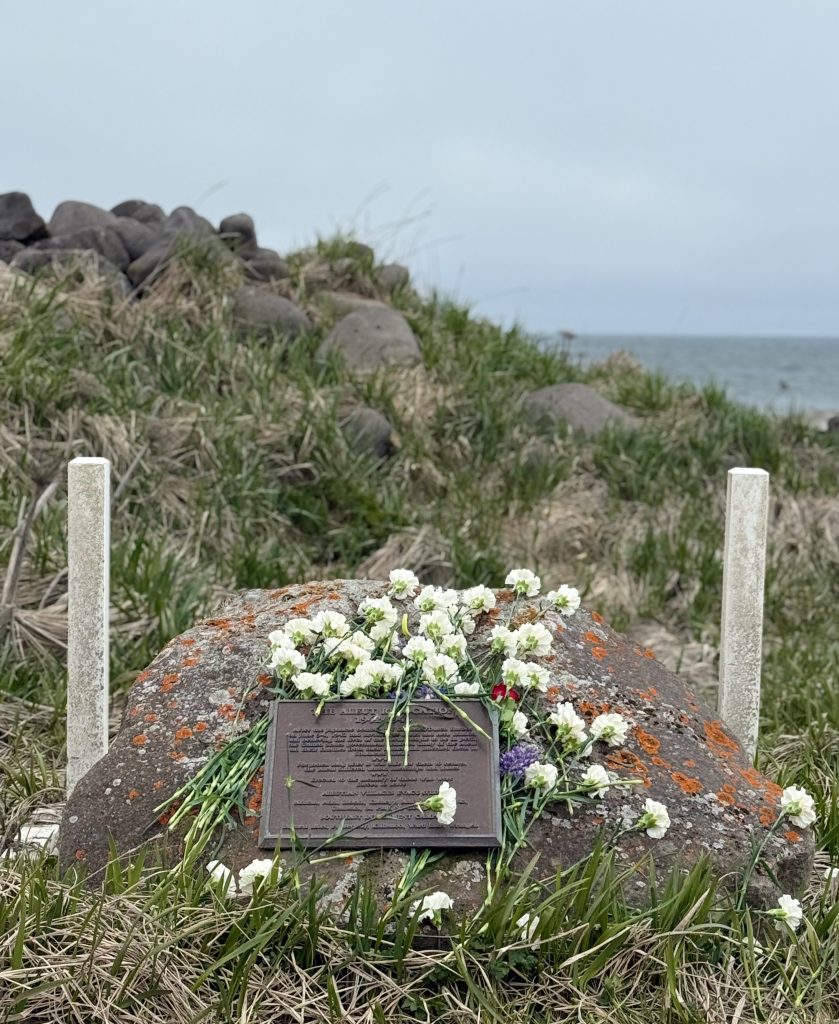
For those unfamiliar with the history of the Pribilof Islands, one thing I am beginning to understand is that the evacuation cannot be separated from what came before it.
For generations, life on St. Paul and St. George was shaped by federal control and the demands of the fur seal industry. The Unangan people whose ancestors had been brought to the islands to work in the seal harvest lived under restrictions that limited travel, employment, and many aspects of daily life. The islands were home, but many decisions affecting life there were made far away.
Many people living on St. Paul in 1942 had spent their entire lives on the island. Few would have known much of the wider world beyond the Bering Sea.
In 1942, war reached the Aleutians.
Following the Japanese occupation of Attu and Kiska and the bombing of Dutch Harbor, the United States government ordered the forced evacuation of Unangan communities from the Aleutian and Pribilof Islands. Families were given little time to prepare. They left behind homes, belongings, churches, and communities, uncertain if they would ever return.
The journey itself was difficult. What awaited them was worse. Many were sent to hastily arranged internment camps in Southeast Alaska, where the facilities were overcrowded and poorly supplied. Sanitation was inadequate. Medical care was limited. Buildings leaked and offered little protection from the weather. Disease spread, people suffered, and some died. Nearly one in ten evacuated Unangan people did not survive the war years.
When the war ended, survivors were finally allowed to return home. The return was not the homecoming many had imagined. Many found houses damaged, neglected, or looted. Personal belongings had disappeared. Buildings had deteriorated during their absence. On St. Paul, the Russian Orthodox church had been vandalized and desecrated while residents were gone.
The losses extended beyond property. Families had buried loved ones far from home. Years had been taken from them. The disruption and grief would echo across generations.
And still, the community continued.
Families returned to damaged homes, repaired what they could, and carried forward what had not been taken from them. But it would be too simple to say that everything endured. Language, culture, and traditions were deeply harmed by generations of control, forced labor, separation, and removal. Much has had to be protected, relearned, renewed, and fought for. That work continues today.
That ongoing work was on my mind during the walk. What stayed with me most was how the remembrance held both grief and family togetherness. It did not feel performed. It felt carried.
I left the walk grateful for the opportunity to listen, learn, and remember alongside a community that continues to do that work.
On Juneteenth, I find myself thinking about the histories we inherit, the histories we are taught, and the histories we have to go looking for. Some of our family stories may connect us to people who suffered. Some may connect us to people who caused harm, benefited from it, or simply lived alongside it. Many of us may find no direct connection at all.
But all of us inherit the responsibility to learn.
If this history is new to you, as it was once new to me, I hope you will spend some time with it. Read. Listen. Ask questions. Seek out the stories that were left out. Not because they diminish our country, but because they help us understand it more fully.
The stories we leave out can be just as important as the ones we tell. May we have the courage to seek them out.
Learn More
Readers interested in learning more about the evacuation and internment of Unangan people during World War II may wish to begin with:
- Aleut Story (documentary film)
- The Aleut Evacuation and Internment During World War II by the National Park Service
- The Forgotten War: The Aleutian Campaign of World War II
- The Alaska Humanities Forum’s resources on the Unangan evacuation
- Oral histories and historical materials from the Pribilof Islands and Aleutian communities
I have also compiled a collection of books, films, reports, and historical resources related to St. Paul Island, the Pribilof Islands, and Unangan history that helped me begin learning this history myself [St. Paul Island Resources].
Join Small Wonders
Join me as I explore overlooked history, life on a remote Alaskan island, family connection, nature, stories, and wonder.
No schedule. No noise. Just occasional notes when there’s something worth sharing.
Join Small Wonders
Stories, nature, books, family connection, recipes, overlooked history, and the small things that make life feel full.
No schedule. No noise. Just occasional notes when there’s something worth sharing.
